
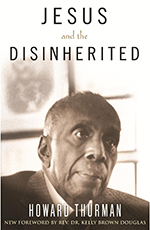
 Reviewed by: Pam Hinrichs
Rev. Howard was a nationally recognized theologian, religious leader and author. He was the first Black dean of Boston University's Marsh Chapel and co-founder of the Church for the Fellowship of All Peoples. He was raised by his grandmother, a former slave. He was a contemporary of Martin Luther King, Senior.
Brief Summary
This book was first published in 1949. It is as relevant now as it was then. It was written to the Black community but is instructive for all as we, as followers of Christ, address, understand and resist racism today.
In the forward by the Very Reverend Kelly Brown Douglas, PhD., she describes the book as "nothing less than those conversations Black parents must have with their children in a world that denies the created sacredness of their Black humanity."
As Thurman says, he was attempting to explore and explain "what the teachings of Jesus have to say to those who stand at a moment in human history with their backs against the wall . . . the poor, the disinherited, the disposed." Again as Rev. Douglas says, "In essence he was surveying the world of the oppressed and asking how it might be possible for human beings to endure the terrible pressures of the dominating world without losing their humanity, without forfeiting their souls."
Thurman sees the parallels between the life of Jesus and the oppressed. He sees, in Jesus' life and time, the role of empire in the lives of those who are members of the favored group and those who are not. Thurman also explores the role of Paul's social and cultural location, and how that likely affected his way of thinking.
Quotes
"Sincerity in human relations is equal to, the same as, sincerity to God. If we accept this explanation as a clue to Jesus' meaning, we come upon the stark fact that the insistence of Jesus upon genuineness is absolute; man's relation to man and man's relation to God are one relation". P. 62.
"Neighborliness is non-spatial; it is qualitative. A man must love his neighbor directly, clearly, permitting no barriers between." P. 79