
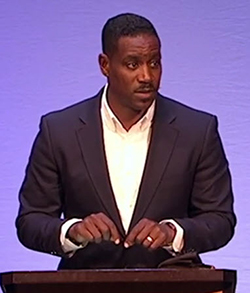
 Justin Giboney on YouTubeLast month, several members of the J&RR team trekked across the bridge to Bethany Community Church for their annual Ministry of Racial Justice and Reconciliation Speaker Event. This year featured Justin Giboney, the founder and president of the AND Campaign, an organization dedicated to helping Christians offer a more faithful public witness and engagement.
Giboney spoke about what it looks like to be a peacemaker today in the public square in our public faith, drawing from his new book Don't Let Nobody Turn You Around. Noting that our current environment feels very polarized, he pointed out that the context that Jesus lived in was also very polarized. Living under Roman occupation, different groups within Jesus' Jewish community responded to that tension in different ways. Some responded with violence and terrorism, some with assimilation, and others used the occupation to maintain power within their own community.
But Jesus doesn't join any of these groups. He does something completely different. He changes how we see ourselves and how we see our enemies. Giboney points out, "He even goes so far as to say crazy things like love your enemy." To be peacemakers in this moment, we start with changing how we see ourselves and changing how we see others, especially our opposition. He notes that there are important debates to be had about issues in our country, but that how these debates happen and how we treat people who disagree with us when they happen is what matters most.
Giboney defines our public witness as "a testimony to society about what we believe is good and true and what is false, immoral, and unjust. It tells others what we value, what we represent, and who we serve." He also notes that our public witness doesn't belong to us, it belongs to God. 2 Corinthians 5:20 says, "We are ambassadors of Christ as though God were making his appeal through us." Giboney challenges us to take that verse seriously and consider how it might change how we interact with others.
Using the Black Church in the Civil Rights Movement as an example, Giboney laid out four ways that their public witness was distinctive. They connected the spiritual to the sociopolitical. They sang gospel hymns as they marched as a discipline to remind them who they were supposed to be and what Christian principles they needed to stand by. They upheld social justice AND moral order. A society that is morally disordered will not have justice, and an ordered society will not be moral without justice. Giboney said, "You can lean left or lean right, but you have to have a prophetic distance to be able to critique both sides." They acknowledged the potential of wickedness not just in their opponents, but also in themselves.
When we have disagreements, it should look different in a way that points people to Christ. "We should always look at people and value people not just based on their behavior at the moment, but who they are and whose image they were made in." They chose moral imagination over contempt and cynicism. "Moral imagination is the ability to see what ought to be and what will be based on God's character and God's promises."
We invite you to watch Giboney's whole talk as well as the panel discussion that followed:
Peacemaking and Public Faith: A Conversation with Justin Giboney