
White settlers saw land for the taking. They failed to consider the perspective of the people already here.
In The Land Is Not Empty, author Sarah Augustine unpacks the harm of the Doctrine of Discovery--a set of laws rooted in the fifteenth century that gave Christian governments the moral and legal right to seize lands they "discovered" despite those lands already being populated by indigenous peoples. Legitimized by the church and justified by a misreading of Scripture, the Doctrine of Discovery says a land can be considered "empty" and therefore free for the taking if inhabited by "heathens, pagans, and infidels."
In the days and months after Pearl Harbor, the lives of Japanese Americans across the continent and Hawaii were changed forever. In this unforgettable chronicle of war-time America and the battlefields of Europe, Daniel James Brown portrays the journey of Rudy Tokiwa, Fred Shiosaki, and Kats Miho, who volunteered for the 442nd Regimental Combat Team and were deployed to France, Germany, and Italy, where they were asked to do the near impossible.
God is up to something! And his plans are far greater than you might imagine. Christianity is not merely about isolated individuals going to heaven. It's about God transforming the entire world and making things right. Sicknesses will be healed, sins will be forgiven, injustice will be eradicated, and all creation will be redeemed. But this is not merely a distant future. It's happening now through what Jesus came to establish--the kingdom of God.
Have you ever had a conversation about racism that went sideways fast? Or have you avoided a conversation because you were afraid you might say something wrong? In this helpful book, Pastor Isaac Adams shows us how to have conversations about racism that are rooted in biblical principles. Using a hypothetical racially charged tragedy as the backdrop, he role-plays conversations between people of varying perspectives, and then gives pastoral counsel to each person in the conversation.
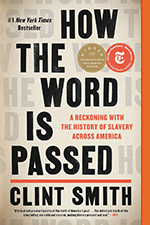
In this beautifully written book, Clint Smith leads us on a tour of the monuments and landmarks that tell the story of slavery in America. Smith transports us to locations like Monticello, the Whitney Plantation, and Angola Prison, painting a picture of both the present and the past. He brings these locations to life through interviews with people he encounters on his journey, deep historical research, and his own reflections on how he experiences each location.
Additional Resources
If you don't have time to read the book, check out one of these videos or podcast episodes and join the discussion.
The New York Times Book Review Podcast – June 25, 2021
The first 30 minutes of this podcast episode feature an interview with the author Clint Smith about How the Word is Passed.
A Reckoning with the History of Slavery in the U.S.: Author Clint Smith | Amanpour and Company
This interview provides a brief introduction to the book. (17 min)
Slavery in America: The Constitution to Reconstruction with Clint Smith
This extensive interview from the National Constitution Center provides an overview of the entire book. (53 minutes)
Book Details
 |
|
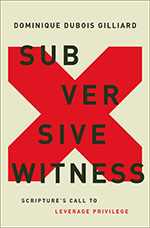
 In Subversive Witness, Dominique DuBois Gilliard inspires readers to reimagine how they think about privilege and exercise power. Instead of denying the existence of privilege or feeling incapacitated by it, Christians can learn to wield privilege subversively as an instrument to advance the kingdom and sacrificially love our neighbors, particularly those who have been disenfranchised by the abuse of power.
Dominique illustrates how the faithful witness of biblical figures, from Esther to Zacchaeus, provides a blueprint for modern believers who desire to pick up the baton as drum majors of justice. By embodying Scripture's subversive call to leverage – and at times forsake – privilege, readers will learn to love their neighbors sacrificially, enact systemic change, and grow more Christlike as citizens of God's kingdom.
If you're not a reader, or if you want to dig in even deeper, check out one of these excellent interviews with the author and join us for the discussion.
- Perkins Fall Series: Subversive Witness - YouTube
- Holy Post Podcast – Episode 485 (Interview begins at 53:32)
- Be the Bridge Podcast – Episode 35
Book Details
 |
|
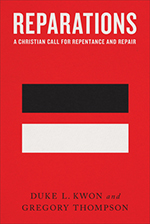
In this prophetic blend of history, theology, and cultural commentary, the authors reveal the far-reaching, damaging effects of the "Doctrine of Discovery." As other nations have instituted truth and reconciliation commissions, so do the authors call our nation and churches to a truth-telling that will expose past injustices and open the door to conciliation and true community.
Reparations explores the church's responsibility for the deep racial brokenness at the heart of American culture, investigates the Bible's call to repair it, and offers a vision for the work of reparation at the local level.
Book Details
 |
|
Page 3 of 9