
Reviewed by: Heather Hedlund
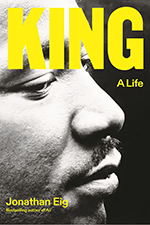 In the words of the author, "This book tells the story of the man who, in a career that spanned a mere thirteen years, brought the nation closer than it had ever been to reckoning with the reality of having treated people as property and secondary citizens." Eig does not shy away from presenting a complicated portrait of Martin Luther King, Jr. He writes, "King was a man, not a saint, not a symbol." Eig makes use of a multitude of recently available material as well as hundreds of interviews to help us get a more complete picture of King.
As I read this book, I found myself thinking about the challenges of leadership. Something that I admire and try to emulate was King's dedication to making sure that his civil rights actions were consistent with his Christian ethics. His unwavering commitment to nonviolence and his insistence on loving enemies were rooted in his faith in Jesus. I also took some comfort in seeing some of the chaos behind the movement. From the outside, it can seem like all their actions were well-thought-out and part of a master strategic plan, but often it seemed that they didn't know what to do and were making it up as they went along. His wife Coretta shared that as the civil rights movement began to change, he became very depressed because he felt like people expected him to have a creative solution and he didn't. "He said people expect me to have answers and I don't have any answers." That was reassuring because I feel that way too, sometimes.
Most impactful for me was seeing how King shouldered the weight of leadership. It is really easy to look at our leaders and think that it's obvious they should speak up on an issue and what they should say. I do this all the time. But when I'm the leader and I have to figure out whether or not to respond to an issue and what to say about it, it's a lot more complicated. This became very apparent to me as I read about how King grappled with speaking up about his opposition to the Vietnam War. When King started speaking up, his view was very controversial, but he felt that taking the Gospel seriously demanded it.
Our pastors and Christian leaders constantly walk a line of how to speak the truth of the Gospel on specific issues without being perceived as too political and driving people away or undermining some other aspect of their mission. King seemed to wrestle with the same dilemma. Speaking up would damage his relationship with President Johnson, who had been a key supporter of civil rights legislation. King also faced opposition from his fellow civil rights leaders who thought that talking about peace in Vietnam would distract from the civil rights movement at home. As the main spokesperson for the movement, King knew that speaking up could be the wrong tactical decision and could hurt the movement, but ultimately he couldn't ignore his conscience. "I feel so deep in my heart that we are so wrong in this country," he explained, "and the time has come for real prophecy, and I am willing to go that road."
King was right about the consequences. He did lose Johnson's support and speaking up did cost him, and thus the movement, popular support. Just like in the Old Testament, prophets are rarely popular in their day. Reading about King's struggle to navigate this decision gave me a lot of empathy for the people who lead me, including our pastors. Am I as quick to pray for them as they walk this tightrope as I am to criticize them when I think they're getting it wrong? In this season where every day seems to bring a fresh controversy, I am taking away from this book a renewed commitment to pray that God will give my leaders wisdom, discernment, and courage, and that the mantle of responsibility will not weigh too heavily on their spirits.