
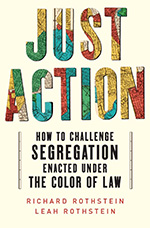
The Color of Law brilliantly recounted how government at all levels created segregation. Just Action describes how we can begin to undo it.
In his best-selling book The Color of Law, Richard Rothstein demolished the de facto segregation myth that black and white Americans live separately by choice, providing "the most forceful argument ever published on how federal, state, and local governments gave rise to the reinforced neighborhood segregation" (William Julius Wilson). This landmark work―through its nearly one million copies sold―has helped to define the fractious age in which we live.
The Color of Law's unrefuted account has become conventional wisdom. But how can we begin to undo segregation's damage? "It's rare for a writer to feel obligated to be so clear on solutions to the problems outlined in a previous book," writes E. J. Dionne, yet Richard Rothstein―aware that twenty-first-century segregation continues to promote entrenched inequality―has done just that, teaming with housing policy expert Leah Rothstein to write Just Action, a blueprint for concerned citizens and community leaders.
See additional resources in this article published in our blog: Just Action: Author Talk and Podcast
Book Details
 |
|
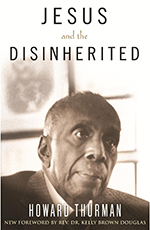
Famously known as the text that Martin Luther King Jr. sought inspiration from in the days leading up to the Montgomery bus boycott, Howard Thurman’s Jesus and the Disinherited helped shape the civil rights movement and changed our nation’s history forever.
In this classic theological treatise, the acclaimed theologian and religious leader Howard Thurman (1900-1981) demonstrates how the gospel may be read as a manual of resistance for the poor and disenfranchised. Jesus is a partner in the pain of the oppressed and the example of His life offers a solution to ending the descent into moral nihilism. Hatred does not empower--it decays. Only through self-love and love of one another can God's justice prevail.
Book Details
 |
|
Nobel Laureate Desmond Tutu has long been admired throughout the world for the heroism and grace he exhibited while encouraging countless South Africans in their struggle for human rights. In God Has a Dream, his most soul-searching book, he shares the spiritual message that guided him through those troubled times. Drawing on personal and historical examples, Archbishop Tutu reaches out to readers of all religious backgrounds, showing how individual and global suffering can be transformed into joy and redemption. With his characteristic humor, Tutu offers an extremely personal and liberating message. He helps us to "see with the eyes of the heart" and to cultivate the qualities of love, forgiveness, humility, generosity, and courage that we need to change ourselves and our world.
Doing Justice introduces people of faith to congregation-based community organizing rooted in the day-to- day struggles and hopes of urban ministry. Drawing from the authors decades of experience in community organizing ministry and skillfully illustrated with examples, Dennis A. Jacobsen weaves theological and biblical warrants for community organizing into concrete strategies for achieving justice in the public arena and discusses fundamental organizing principles like power, self-interest, and agitation.
On any given night, more than half a million Americans and Canadians find themselves sleeping on the streets, in shelters, cars, and other places not meant for human habitation. Yet as this crisis continues to grow, it remains one of the least talked about—especially in churches. Even where compassion and empathy exist, the complexities around homelessness can make us feel stuck, overwhelmed, or numb to the existence of unhoused people in our cities and neighborhoods.
Reporting back from his work in homeless services, minister and advocate Kevin Nye introduces readers to the Christ he's met in tents, shelters, and drop-in centers. He demystifies homelessness by journeying into complex issues like affordable housing, mental illness, addiction, and more, while reimagining our theological approach to these matters and educating us on how they intersect with homelessness.
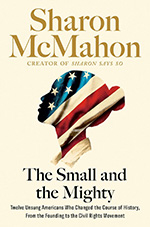
In The Small and the Mighty, Sharon McMahon proves that the most remarkable Americans are often ordinary people who didn't make it into the textbooks. Not the presidents, but the telephone operators. Not the aristocrats, but the schoolteachers. Through meticulous research, she discovers history's unsung characters and brings their rich, riveting stories to light for the first time.
You'll meet a woman astride a white horse riding down Pennsylvania Ave, a young boy detained at a Japanese incarceration camp, a formerly enslaved woman on a mission to reunite with her daughter, a poet on a train, and a teacher who learns to work with her enemies. More than one thing is bombed, and multiple people surprisingly become rich. Some rich with money, and some wealthy with things that matter more.
This is a book about what really made America – and Americans – great. McMahon's cast of improbable champions will become familiar friends, lighting the path we journey in our quest to make the world more just, peaceful, good, and free.
Book Details
 |
|
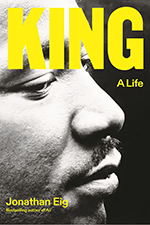
Vividly written and exhaustively researched, Jonathan Eig s King: A Life is the first major biography in decades of the civil rights icon Martin Luther King Jr.―and the first to include recently declassified FBI files. In this revelatory new portrait of the preacher and activist who shook the world, the bestselling biographer gives us an intimate view of the courageous and often emotionally troubled human being who demanded peaceful protest for his movement but was rarely at peace with himself. He casts fresh light on the King family s origins as well as MLK s complex relationships with his wife, father, and fellow activists.
King reveals a minister wrestling with his own human frailties and dark moods, a citizen hunted by his own government, and a man determined to fight for justice even if it proved to be a fight to the death. As he follows MLK from the classroom to the pulpit to the streets of Birmingham, Selma, and Memphis, Eig dramatically re-creates the journey of a man who recast American race relations and became our only modern-day founding father―as well as the nation s most mourned martyr.
Book Details
 |
|
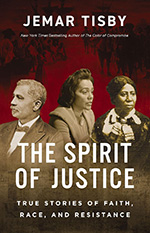
How is it that people still work for change after continuously seeing the worst of humanity and experiencing the most demoralizing setbacks? What keeps them going? It is that spirit of justice that rises up "like a war horse," as Myrlie Evers-Williams famously said. It is a sense in the hearts of people who hunger and thirst for righteousness.
The Spirit of Justice reveals the stories of the people who fought against racism and agitated for justice—and what we can learn from their example, their suffering, their methods, and their hope.
In this book, award-winning author Jemar Tisby will open your eyes to the "pattern of endurance" in the centuries-long struggle for Black freedom in America. Through a historical survey of the nation from its founding to the present day, this book gives real-world examples of people who opposed racism, how they did it, what it cost, and what they gained for themselves and others.
Book Details
 |
|
More Articles …
Page 1 of 4
Latest Events
| 10 Nov 2026; 07:00PM - 08:30PM BelPres J&RR Monthly Meeting |
Latest Blog Posts
- Putting Faith into Action
- The America That's Still Possible
- Bellevue International Festival
- Bellevue College Rededicates "Never Again Is Now" Mural
- Peacemaking and Public Faith
- 2026 Juneteenth Community Celebrations
- Responses to the Supreme Court Ruling on the Voting Rights Act-April 2026
- Reflections on My Personal Civil Rights Pilgrimage
- Walking Tours with the Wing Luke Museum
- Justice & Racial Reconciliation Leadership – Past, Present, and Future
- Cultural Conversations Facilitator Course
- Remembering Dr. John M. Perkins